How to Be Good at NYT Connections: A Faster Way to Solve Every Day
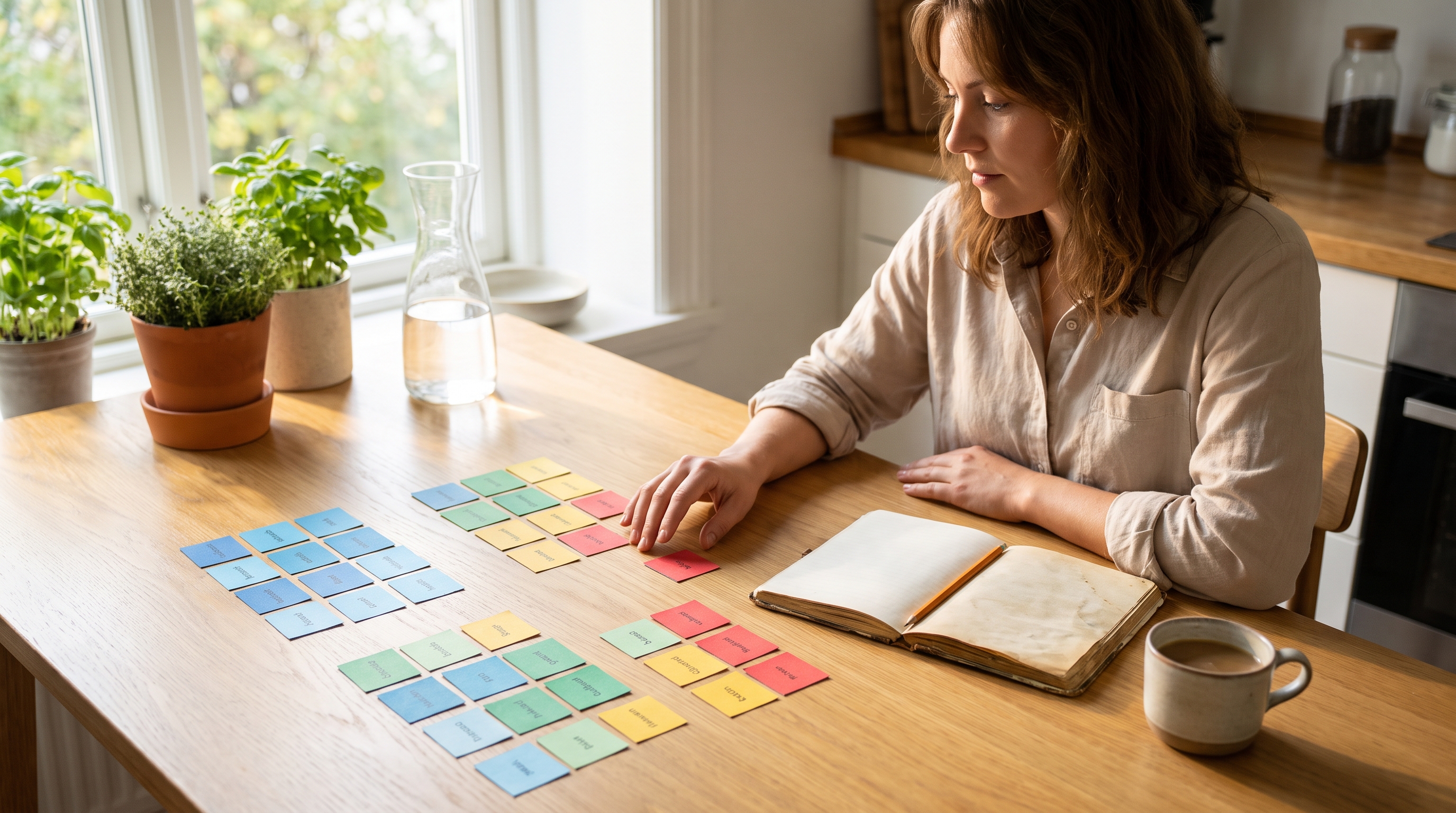
Connections looks like a game about knowing words. It is a game about knowing how the New York Times writes clues. The sixteen words on the board are the easy part; the difficulty lives in the traps the puzzle sets around them. If you have wondered how to be good at NYT Connections, the answer is not a bigger vocabulary. It is learning to see those traps coming. Here is how to do it, and what to do differently the next time the board fights back.
How the board actually works
Every Connections puzzle gives you sixteen words to sort into four hidden groups of four. You pick four words that share a connection and hit Submit, and you get only four attempts in total, which is why guessing carelessly is expensive. The connection can be almost anything: letter counts, hidden extra letters, economics, fairy tales, whatever the setter has thought up.
The colour system tells you roughly how hard each group is before you touch it. Yellow is the simplest and purple is the most difficult. The overall difficulty number you see published each day, like the 2.9 out of five for one recent puzzle, is an average of ratings from a paid panel of testers who solve each puzzle in advance to catch bugs and inconsistencies. A higher number means a harder board.
The category-spotting method
You do not have to stare at sixteen words and wait for inspiration. Work the board the way the puzzle is built, easiest layer first.
Start with the yellow group. Those words usually stick out because they have so much in common, often near-synonyms of one another. One recent solver worked the whole board in exactly that order, yellow, green, blue, purple, and finished without a single mistake. That is not luck. It is the method: take the obvious group off the board first, and the remaining twelve words have fewer places to hide.
Check the parts of speech next. If some words are verbs and others are nouns or adjectives, group them mentally by that and see whether a pattern jumps out. Then test whether any set is a run of synonyms, but hold that reading loosely, because the puzzle deliberately throws in words that are sometimes synonyms to mislead you.
Say the words out loud. In one past puzzle, go, rate, faster, clip, pace, speed, move, commute and hurry all looked related to motion, but saying them made it obvious that only four, go, move, hurry and faster, were things you would actually say to get someone moving. The words that fit a category in more than one way are the ones to be suspicious of.
Flip it around when you are stuck: find a word with only one possible context and build a category outward from it.
The traps that cost you a whole attempt
Every experienced player has a story about the group they were sure of. The puzzle is built to produce exactly that story.
The classic trap is the red herring: three or four words that group together plausibly and wrongly. Bud, Corona and Light look like a beer category, and they were not one. The setters know you will reach for the obvious link, so they seed the board with links that are almost right.
The other trap is the word that belongs to two groups at once. In one puzzle, a player grouped id with ego, saw it might be a trap, and tried the possessive-words group first instead. In another, a player was convinced one of the clues was Mario Bros. and burned three tries on Peach, Princess, Donkey, Turtle, Mushroom and Kingdom. One of them wasted three tries on a group built around one wrong conviction; the other spotted the trap in time.
The game gives you a tool for exactly this situation. When you submit a wrong group, read the message at the top of the board: "One away" means only one word was wrong, so analyse each word to find the one that fits better elsewhere and swap it. That single message turns a failed guess into most of a solved group, and it is the difference between losing an attempt and losing the game. It is diagnosis before action, the same combination the Draghi report on Europe's competitiveness brought to a bigger problem: a clear diagnosis, then concrete recommendations.
If the board will not resolve, shuffle it. You can shuffle as many times as you like, and seeing the words in a different order is often what breaks a stuck reading.
When to walk away
The counterintuitive move, the one that saves streaks, is stopping. If you are stumped, come back to the puzzle later with a fresher mind; trying to force a difficult board without sleeping on it tends to produce too many mistakes. The board is not going anywhere, and the puzzle is designed to confuse you, so taking a peek at a hint is nothing to feel bad about.
Where the same skill gets a second workout
Everything above is one skill: take a set of hints that do not name the answer, and find the thread that ties them together. Connections exercises it by sorting words into hidden categories. If you want more of exactly that, Clume is a daily word game built on the same deduction. Every day it presents one hidden word and up to ten clues: you begin with the first clue and make a guess, and if the guess is wrong, the next clue is revealed. The aim is to find the answer using as few clues as possible. There are no coloured letters and no fixed word length to lean on, so the work is working out what the clues have in common and which answer best explains all of them. It suits the same crowd: people who enjoy crosswords, cryptic crosswords, Sudoku, Connections, logic puzzles, riddles and lateral-thinking problems. If that sounds like your kind of puzzle, it is the same deduction in a different wrapper.
The habit transfers, too. A clue-based deduction puzzle trains you to distrust your first association and wait for the pattern to resolve, and that skill does not stay inside the game tab when you close it.