How to Use Clues to Narrow Down a Word Puzzle
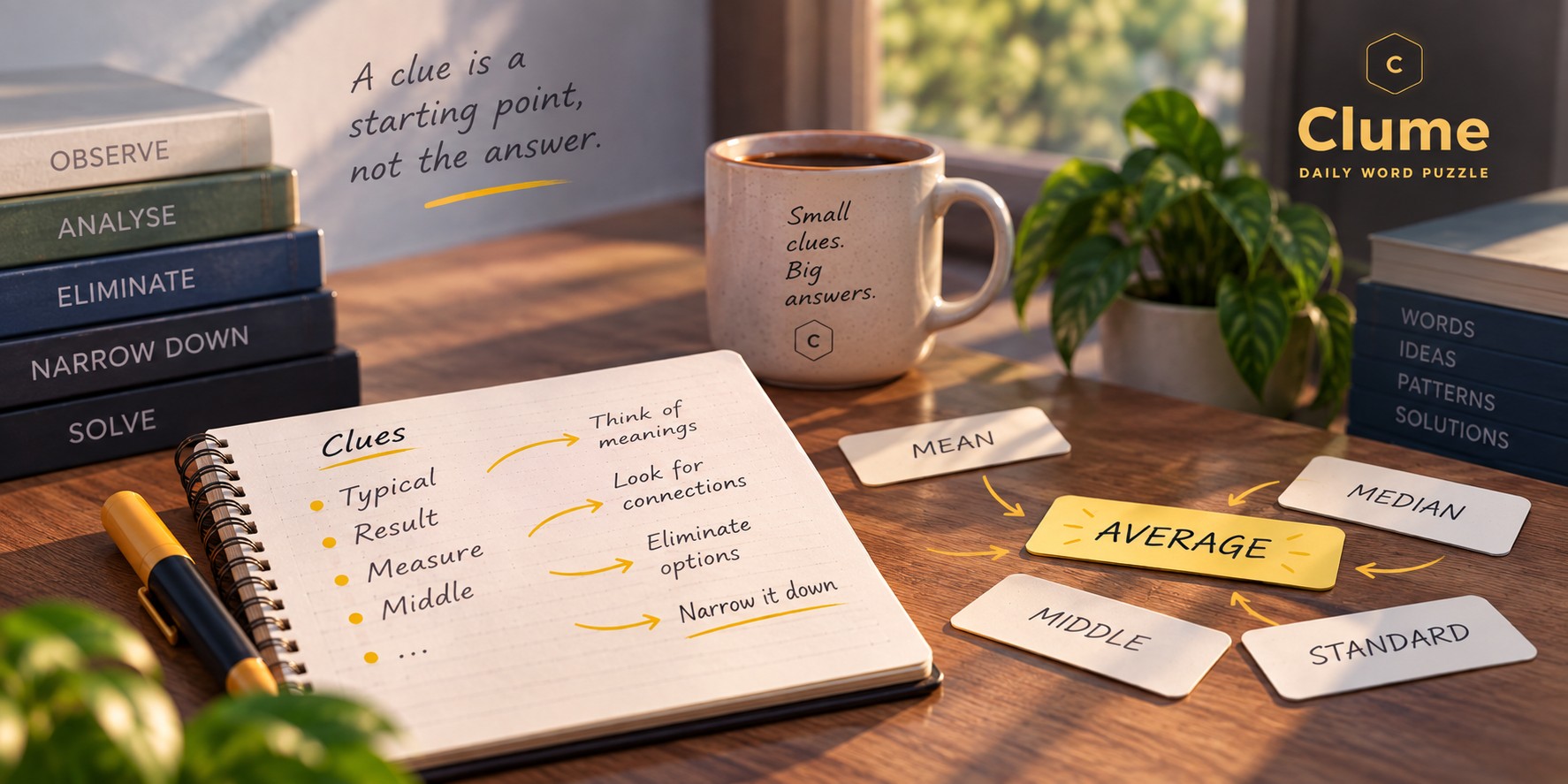
Good word puzzle solving is not about guessing randomly. It is about using each new clue to reduce the number of possible answers.
Most daily word puzzle players guess and hope. They throw out a word, scan the feedback, and throw out another. It works often enough. But it leaves a lot of solving power on the table.
Clume gives you ten chances to guess a hidden word. You begin with one clue, and each incorrect guess reveals another. That structure changes the game. Instead of brute-forcing through letter combinations, you gradually build a case for the answer as more clues appear. The question is how to read those clues well.
Start With What a Clue Rules Out
A clue’s value is not just what it tells you. It is also what it eliminates.
Say the first clue suggests something connected with travel. That single piece of information removes thousands of unrelated words. You are no longer guessing from the entire dictionary. You are working inside a broad but useful boundary.
This is worth pausing on. Players often rush to enter the first word that comes to mind, treating the clue as a loose association rather than a filter. But a clue that eliminates whole categories of words can be more useful than it first appears.
Before you type a word, ask: what does this clue make unlikely or impossible? That negative space is where much of the strategy lives.
Layer Clues Instead of Replacing Them
When a second or third clue appears, the temptation is to pivot completely. The latest clue may feel more specific, so you drop the earlier ones and chase the new idea. This is a common mistake.
Clues compound. The first narrows the field. The second narrows it further, but the answer still needs to make sense alongside the first. If one clue suggests travel and the next suggests industry, you need a word connected with both.
Keep a mental or physical list. Each new clue is another filter stacked on the previous ones. The answer should usually sit at the intersection of all the clues revealed so far.
A guess that fits only the newest clue but ignores the earlier ones is likely to waste one of your ten chances.
Think About Different Types of Connection
Not every clue points to the answer in exactly the same way.
One clue might describe the answer directly. Another might name something associated with it. A later clue might refer to a place where it is found, an action connected with it, a common phrase containing it, or a broader category it belongs to.
For example, one clue may suggest a setting, while another suggests a person, object, or activity commonly found there. The answer may connect them without being a direct synonym for either clue.
This means you should avoid forcing every clue into the same kind of relationship. Ask how each clue could connect to the same answer, rather than expecting every clue to define it in the same way.
Use Early Guesses as Probes
In Clume, each incorrect guess reveals another clue. That means a wrong answer still changes the information available to you.
Your guesses should therefore be plausible, but they can also be useful tests of your interpretation. If a word seems to fit the clues but turns out to be wrong, do not simply enter a close synonym immediately. Pause and reconsider the full clue set.
Did your guess fit only one clue particularly well? Were you interpreting a clue too literally? Could one of the clues refer to an association, phrase, or category instead?
Treat each guess as part of the reasoning process. The goal is not simply to try words until one works. The goal is to make every new clue improve the quality of your next guess.
Do Not Commit Too Early
An early clue is deliberately broad. Several answers may fit it, and the first idea that comes to mind is not necessarily the strongest one.
This is where players can lose guesses quickly. They recognise one possible connection and immediately commit to it, even though many other words would fit just as well.
Before guessing, try to think of several candidates. Then ask which one has the best chance of remaining plausible after another clue is revealed.
You do not need certainty before making a guess, but you should avoid treating a weak association as if it were proof.
Use Word Shape as a Tiebreaker
Clume does not provide letter-position feedback, so letter frequency is much less important than it is in games such as Wordle. Meaning and clue relationships should always come first.
However, letter patterns can still be useful when you are choosing between two equally plausible words. Common word forms, familiar endings, and likely spellings may help you judge which candidate feels more natural.
WordTips explored letter frequency in detail in its article, The Best Wordle Starting Words According to the Data. Their research used a sample of 40,000 English words and found that some letters appear far more frequently than others.
That kind of information is central to a letter-based puzzle, but in Clume it should only be used as a final tiebreaker. A word with common letters is not more likely to be correct if it does not fit the clues. Always prioritise meaning first.
Build a Checklist Habit
Players who solve consistently tend to follow a quiet routine:
- Read the current clue carefully.
- Consider what it suggests and what it rules out.
- Review every clue revealed so far.
- Think of several words that could connect them all.
- Choose the candidate with the strongest overall fit.
- If it is wrong, study the new clue before guessing again.
- Reassess your earlier interpretation rather than simply trying a synonym.
This is not complicated. But it is disciplined, and discipline is what separates a player who solves after only a few clues from one who reaches the tenth.
The Real Game
Word puzzles reward vocabulary, but Clume also rewards interpretation, flexibility, and deduction.
Every clue adds another piece of evidence. The challenge is to decide how those pieces connect without becoming trapped by your first idea. Players who keep all the clues active, test their assumptions, and change direction when the evidence demands it will usually perform better.
The answer is rarely hidden in one clue alone. It appears in the space where all the clues meet.