How Word Games Build Vocabulary
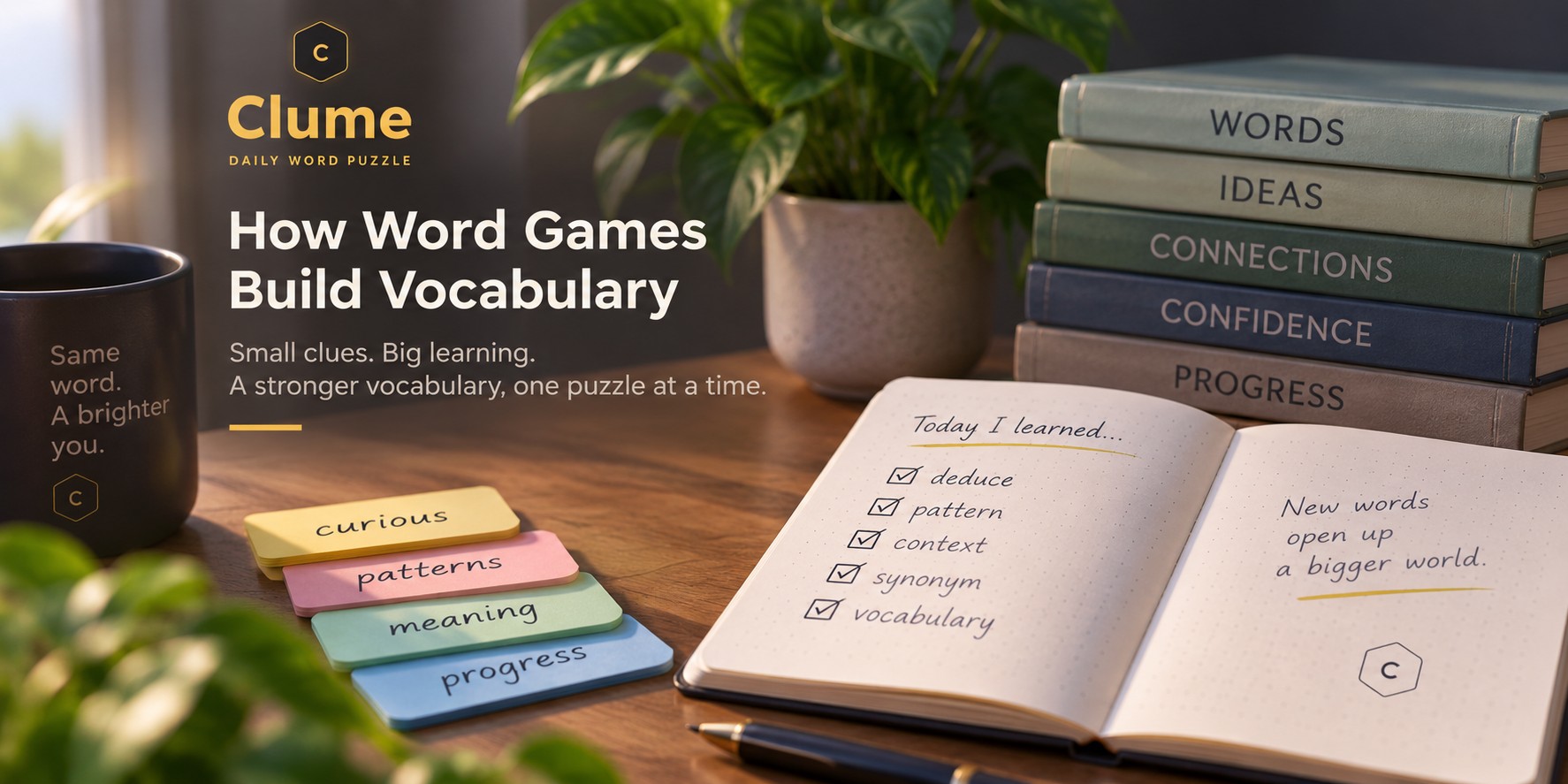
Daily word games do more than entertain. They build vocabulary through repetition, context and the process of testing possible answers.
Most people who play daily word games will tell you they do it to relax, to fill a train ride, or to settle a friendly competition. Few would say they sit down each morning to study vocabulary. And yet that is exactly what happens.
Word games teach vocabulary the same way conversation does: through context, repetition, and low-stakes trial and error. The difference is that a good word game compresses those conditions into a few focused minutes.
Why Guessing From Clues Works
Clume gives you up to ten chances to identify a hidden word, revealing one clue at a time. That structure mirrors how we naturally learn words in the wild. You encounter a word in a sentence, pick up partial meaning, encounter it again somewhere else, and gradually lock it in. Clue-based guessing replicates that cycle in miniature.
Each wrong guess still does useful work. You mentally audition candidates, weighing whether a word fits the clue you have so far. That process forces you to think about definitions, connotations, and category boundaries, all of which strengthen word knowledge even when you guess wrong.
Repetition Without the Flashcard Feeling
Spaced repetition is one of the most studied techniques in memory research. The principle is simple: reviewing information at increasing intervals helps transfer it from short-term to long-term memory. Flashcard apps apply this mechanically. Word games apply it by accident.
A daily puzzle habit means you encounter overlapping pools of words across days and weeks. Monday's answer might share a root with Thursday's. A clue that stumped you last week primes you to recognise a related word this week. The spacing is imperfect but persistent, and persistence is what matters.
Different Games, Different Skills
Not all word games exercise vocabulary in the same way.
Letter-grid games like Wordle and its variants, Dordle and Quordle, focus on orthographic patterns. You learn which letter combinations are common in English, which helps with spelling and word recognition. Solving two or four puzzles simultaneously, as Dordle and Quordle require, adds a layer of working memory pressure that deepens processing.
Clue-based games like Clume emphasise semantic knowledge. You are working from meaning, not from letters. That distinction matters because vocabulary is ultimately about meaning: knowing a word means knowing what it refers to, where it fits, and how it relates to neighbouring concepts.
Word-formation games like Spelling Bee, where you build as many words as possible from a set of seven letters, reward breadth. Players who know more words score higher, which creates a direct incentive to learn obscure but valid options. You start to notice words in your reading that you would have overlooked before, because you want them in your toolkit for the next puzzle.
Making It Stick Beyond the Puzzle
Playing daily is a strong start. A few habits make it stronger.
Look up the answer. When you fail a puzzle or guess a word you half-know, spend 30 seconds reading the definition. That single act converts a vague familiarity into retrievable knowledge.
Play more than one type. Letter-based and meaning-based games reinforce different dimensions of word knowledge. Rotating between them covers more ground than repeating the same format.
Follow curiosity sideways. If a clue mentions a concept you find interesting, follow it. For readers who want structured vocabulary practice beyond daily puzzles, resources like free online vocabulary games for all levels offer collections organised by difficulty, from beginner word searches to exam-prep quizzes for GRE, TOEFL, and IELTS.
The Compound Effect
A single puzzle teaches you very little. A year of daily puzzles teaches you hundreds of words and, more importantly, trains the habit of thinking carefully about language. That habit carries into reading, writing, and conversation.
You do not need to treat word games as study. Just play. The vocabulary follows.