What Is a Deduction Game? How the Genre Works and What to Play
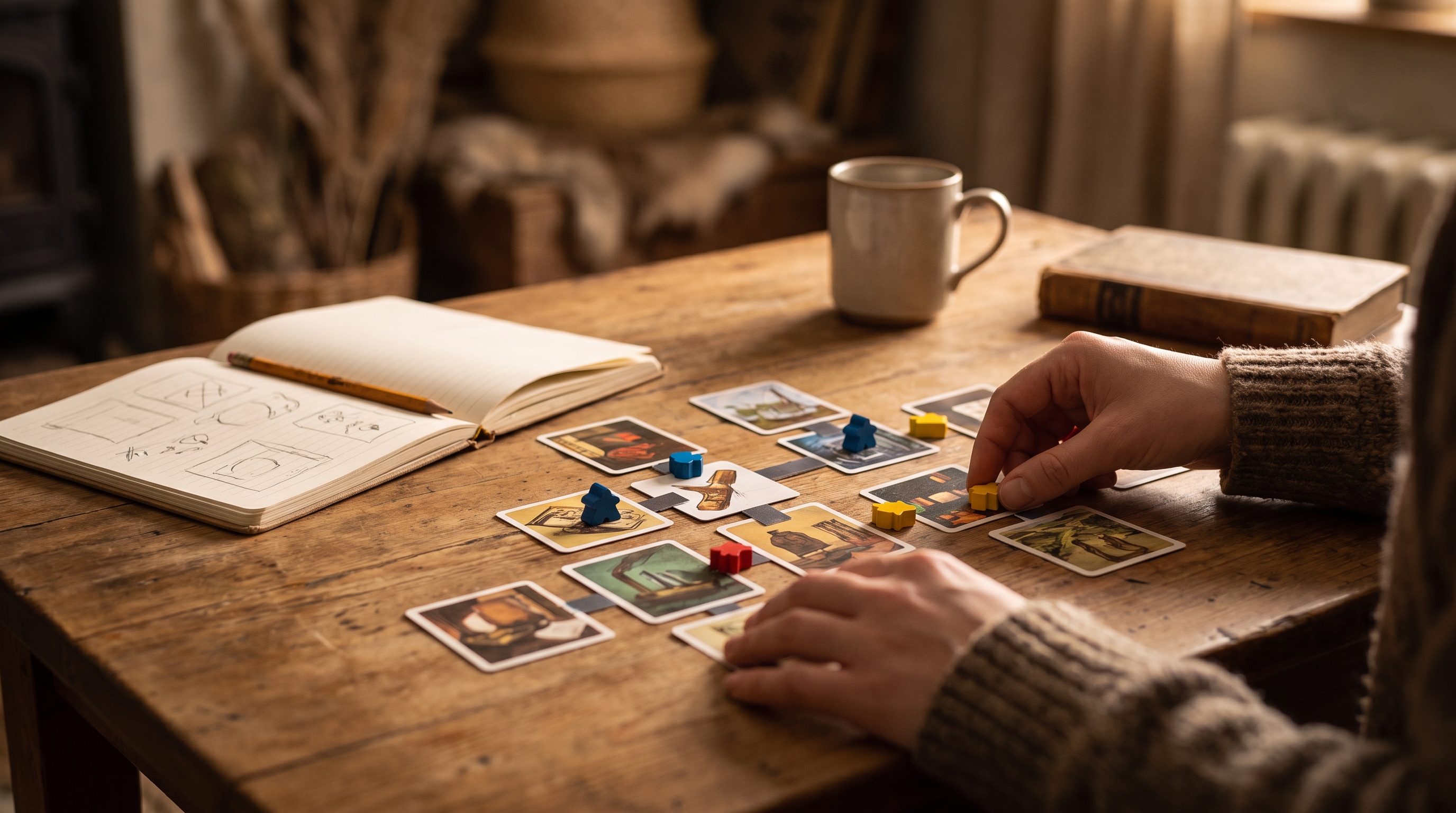
Cluedo, Among Us, Master Mind, and a daily word puzzle all get shelved under the same label, and the label is doing real work: what they share is that reasoning beats recall. You take the information the game gives you and narrow the world down until one answer is left. Here is what a deduction game actually is, the classics that defined the genre, and seven you can play in a browser tonight.
What counts as a deduction game
A deduction game is any game where you use logic to get to the correct answer, whether that means working through an investigation or working out who at the table secretly holds which role. Board games have their own version of the label: deduction board games are the genre where deductive reasoning is the central mechanic, not a skill you lean on occasionally the way bridge or poker players do. Those split into two broad categories, abstract and investigation.
The classics: from Cluedo to Master Mind
Investigation games put you in a detective's seat, playing as police, detectives, or other investigators. Cluedo is the best known of them, and its central trick is so durable it has a name: the Missing Card, developed for the game by Anthony E. Pratt (Cluedo sells as Clue in the United States). A known set of cards loses one or more members, and you gather information until you can say which. Scotland Yard runs the other direction: one player tries to stay hidden while everyone else tries to find them, a setup also used in The Fury of Dracula.
Abstract deduction games drop the theme entirely and leave pure reasoning. Master Mind and Black Box are the notable ones. Some abstract games do introduce random elements: in Code 777, the question cards used to gather information are drawn at random.
The genre has room for oddities too. Mattel's Lie Detector, published in 1960, had players test statements using punch cards and a plastic lie-detector machine. It was popular in its day, but unlike Cluedo or Scotland Yard it left no imitators behind.
Logic puzzles: deduction on paper
The paper branch starts in an unexpected place. Logic puzzles were first produced by Charles Lutwidge Dodgson, better known as Lewis Carroll, the author of Alice's Adventures in Wonderland. His book The Game of Logic asked readers to confirm a conclusion such as "some greyhounds are not fat" from premises like "no fat creatures run well" and "some greyhounds run well", and he went on to build puzzles from as many as eight premises.
The version most people meet in puzzle magazines is the logic grid: a scenario (who brought which dog to the dog show), clues such as "neither Misty nor Rex is the German Shepherd," and a matrix to fill in as you deduce the solution. Most stick to two, three, or four categories, because complexity climbs fast beyond that. The most famous example is probably the Zebra Puzzle, which asks who owned the zebra. In the second half of the twentieth century, the mathematician Raymond Smullyan expanded the branch with his knights and knaves puzzles, where knights always tell the truth and knaves always lie.
The riddle form is still alive. One modern example seats you in a dark room with 1,017 Othello chips, exactly 23 of them black-side-up, and asks you to split them into two piles with equal numbers of black-side-up chips; you are allowed to flip chips over as you go.
Social deduction: when the clues can lie
Social deduction games point the same reasoning at the people around the table: players try to uncover each other's hidden role or team allegiance. The early ones were board and card games, Hoax in 1981 and Mafia in 1986. Video versions began to be created in the 2000s, with early examples including Space Station 13 in 2003, then Town of Salem in 2014 and Among Us, which rose to great popularity in 2020, with the pandemic's forced distance frequently cited as a reason. The format has even reached television: The Traitors, a reality franchise built on the same Werewolf and Mafia blueprint, has been adapted in more than 30 countries.
The difference from every branch above is the source of the information. In the paper and board games, the clues come from the game itself. Here they come from players, who can bluff to keep you from suspecting them; BoardGameGeek files games like Werewolf under signalling, where the feedback you read may not be truthful.
Seven deduction games you can play in a browser
Player counts and playing times below, so you can match the game to the group you actually have.
| Game | Players | Typical time | What you deduce |
|---|---|---|---|
| Codenames | 4-8 | ~15 min | Team leaders give clues to get their teammates to guess a set of words |
| Decrypto | 4-8 | ~15-45 min | Crack your team's code before the other team intercepts your messages |
| Fugitive | 2 | ~10 min | A fugitive plays cards to flee town while the agent tries to guess them |
| Hanabi | 2-5 | ~25 min | Give each other clues that put tiles in the right order for a shared fireworks display |
| Liar's Dice | 2-10 | ~15-30 min | Bluff, or call another player's bluff, without losing a die |
| Wavelength | 4-12 | ~30-45 min | Guess how a player rates a word on a scale, and how close your read landed |
| Avalon | 5-10 | ~30 min | Find the secret evil characters before they derail the group's quest |
A daily deduction game for one
Every game in that table needs at least one other person. If your puzzle window is a quiet few minutes a day, that is the gap Clume was built to fill.
Clume is a daily word deduction game. Each day there is one hidden word and up to ten clues. You start with a single clue and make a guess; if it is wrong, the next clue is revealed. Every new clue adds information, but it also adds to your final clue count, so the aim is not simply to find the answer. It is to find it using as few clues as possible. Everyone receives the same daily puzzle, so you can compare clue counts with friends or share how quickly you solved it.
The clues are built to change meaning as you go. A clue like Interest could suggest finance, curiosity, attention, or attraction. A later clue might make one of those readings more likely, and a later one still might reveal that the answer was never a direct synonym at all, but a larger concept connected to every clue. That is the deduction: holding several meanings in your head at once and letting the evidence choose between them.
Clume never asks you to rearrange letters, find words of a particular length, or recall an obscure definition. The answers are ordinary words, and the challenge is spotting the connection between the clues, which is why it tends to suit people who already enjoy crosswords, cryptic crosswords, Sudoku, Connections, logic puzzles, and riddles. There is one new puzzle every day, with the same word for everyone, and no endless feed behind it: you solve, share if you feel like it, and come back tomorrow. Solving in two or three clues feels impressive. Needing all ten can feel just as satisfying once the answer finally makes sense. A full puzzle normally takes only a few minutes.