Why Some Word Puzzle Guesses Feel Right — But Are Wrong
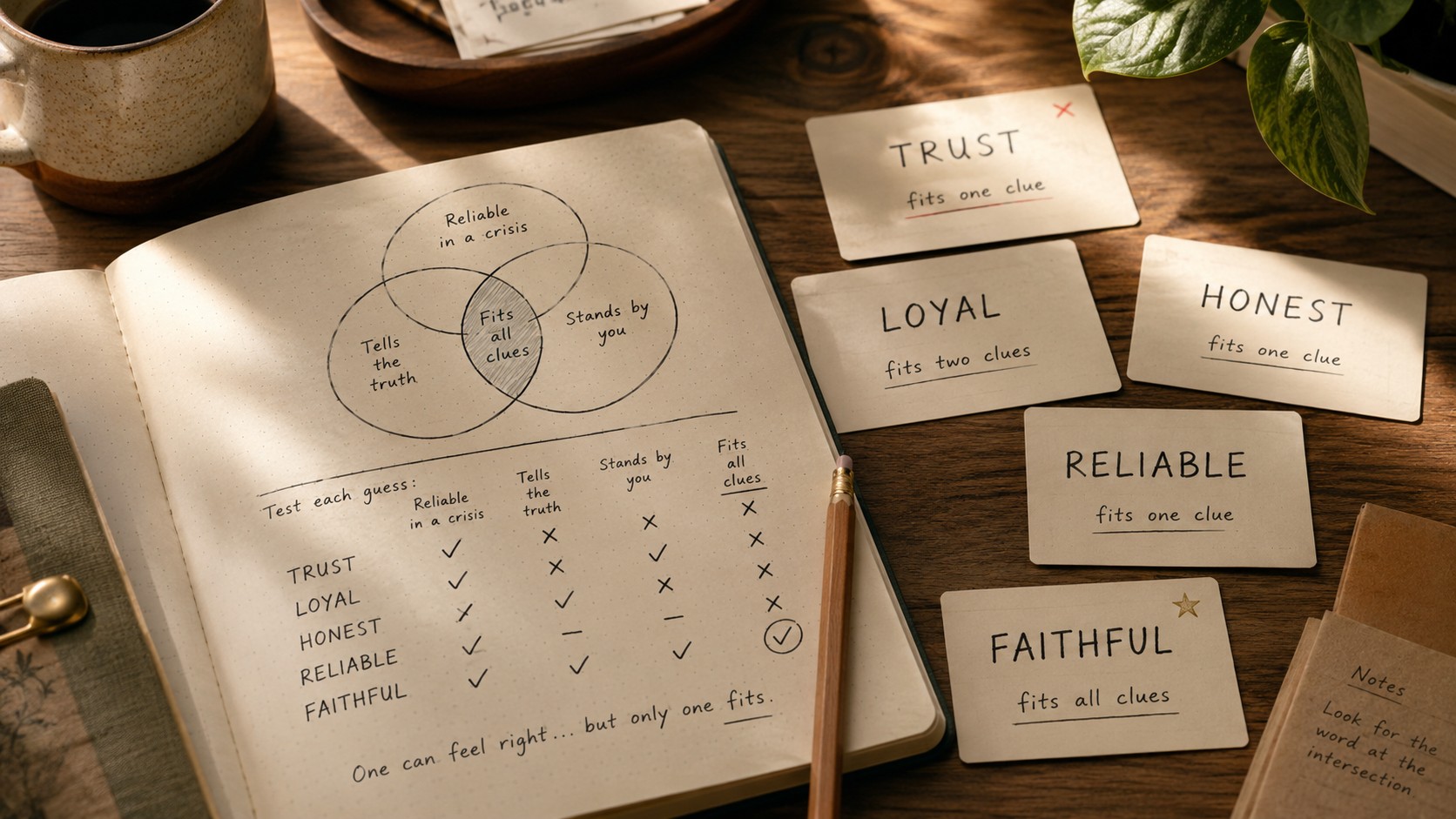
One of the most interesting moments in a word puzzle is when a guess seems to fit perfectly — and is still wrong. The reason usually lies in the difference between fitting one clue and explaining all of them.
Anyone who plays clue-based word games knows the feeling. A clue appears, a word immediately comes to mind, and the connection seems so obvious that entering anything else would feel foolish. Then the game tells you that the answer is wrong.
Sometimes the guess was poor. More often, though, it was entirely reasonable. Language contains overlapping meanings, associations, phrases and categories, so several words can genuinely fit the same clue. The challenge is not simply finding a word that works. It is finding the word that best explains the complete set of evidence.
A Good Guess Can Still Be the Wrong Answer
A wrong answer does not automatically mean the reasoning behind it was bad. If a clue is cold, possibilities might include winter, ice, snow, freezer, frost, chill or even distant, depending on how the clue is being used. Every one of those connections is legitimate.
This is one reason clue-based games differ from straightforward definitions. A dictionary definition is normally designed to identify a word precisely. A puzzle clue may deliberately leave several interpretations open, especially early in the game.
In Clume, an incorrect guess reveals another clue. That new clue is not merely an extra hint. It changes the value of everything you already know. A candidate that looked excellent after one clue may suddenly look weak after two.
Synonyms Are Only One Kind of Connection
A common trap is assuming that every clue is asking for a synonym. Sometimes it is. Often it is not.
Consider a clue such as bright. A player might think of luminous, shining or vivid. But bright can also suggest intelligence, daylight, colour, optimism or even a particular kind of future. The relationship between clue and answer may be grammatical, conceptual, contextual or associative rather than a simple substitution of one word for another.
That makes synonym chasing dangerous. If your first guess is wrong, immediately entering three words that mean almost exactly the same thing usually tests only one interpretation of the clue.
A stronger response is to ask what else the clue could be doing. Is it describing the answer? Is it something commonly found alongside it? Does it form a familiar phrase with the answer? Is it an example of a wider category? Could it describe an effect rather than the thing itself?
The Answer Lives at the Intersection
The most useful way to think about multiple clues is as overlapping circles. Each clue describes a collection of possible words. The correct answer sits where those collections overlap.
Imagine that one clue suggests flight. There are hundreds of possible connections: bird, plane, wing, airport, pilot, feather, journey and many more. Now imagine that a second clue suggests formation. Suddenly some of those candidates become much more interesting than others.
The important point is that the second clue does not replace the first one. Both remain active. By the third or fourth clue, the puzzle is asking you to identify a word capable of connecting several different ideas simultaneously.
This is why a word can feel convincing and still fail. It may sit comfortably inside one circle while falling completely outside another.
Why We Become Attached to the First Idea
There is another problem: once a possible answer enters our mind, it becomes difficult to stop seeing the clues through it.
Suppose your first interpretation points towards school. When the next clue appears, you naturally look for a way to make that clue fit school too. If the connection is weak, you may still accept it because abandoning the idea means starting again.
This is useful in everyday reasoning because keeping a working hypothesis saves effort. In a puzzle, however, it can become a trap. Every clue begins to look like evidence for the answer you already want.
One simple defence is to deliberately generate an alternative interpretation before making the next guess. You do not have to believe the alternative. Its purpose is to stop the first idea from becoming the only idea.
Near Misses Are Interesting for a Reason
Some wrong guesses are much closer than others. A player may identify almost exactly the right concept but choose a different word within the same family, category or meaning.
These are the guesses that can feel particularly unfair in the moment. You may have understood what the puzzle was pointing towards and still not have reached the intended answer.
But near misses also reveal something interesting about language: meanings do not exist in neat isolated boxes. Words form networks. Two words can overlap heavily without being interchangeable.
Take trust, reliable, loyal and honest. They belong to related territory, but each carries a different centre of meaning. A set of clues may strongly support one while only loosely supporting another.
The aim is therefore not to ask, “Can I connect this word to the clues?” With enough imagination, we can connect almost anything. A better question is, “Does this word explain the clues more naturally than the alternatives?”
One Strong Connection Can Be Misleading
Players tend to give too much weight to a spectacular connection.
If one clue has an obvious phrase or association with a particular word, that candidate can feel almost certain. But four moderate connections can provide stronger evidence than one perfect connection accompanied by three awkward ones.
Think of the clues collectively. If you had to explain your proposed answer to another player, could you describe the relationship with every clue without stretching?
If one explanation repeatedly requires phrases such as “sort of”, “maybe” or “if you think about it this way”, your candidate probably deserves another look.
Later Clues Should Change Your Thinking
Another surprisingly common mistake is treating a new clue only as confirmation. Players ask whether it can be made to support their current idea rather than whether it should change that idea.
A new clue is evidence. Sometimes evidence strengthens a theory; sometimes it weakens it.
After every reveal, mentally score your candidates again. A word that was your favourite after clue two does not deserve special treatment at clue five. If another candidate now explains the complete clue set more cleanly, change course.
Good puzzle solving requires a willingness to abandon an answer that once looked excellent.
Wrong Guesses Can Still Be Useful
In a game such as Clume, a wrong guess produces more information because the next clue appears. That means the mistake itself becomes part of the solving process.
The useful question after a miss is not simply “What synonym should I try next?” Instead, ask why your answer failed to distinguish itself from other possibilities.
Perhaps the first clue was broader than you assumed. Perhaps two clues are connected through a phrase rather than a definition. Perhaps you found the correct topic but chose the wrong member of that topic.
Treating misses this way turns guessing into hypothesis testing. You are building an interpretation of the puzzle, testing it, receiving new evidence and revising it.
How to Escape a Plausible but Wrong Answer
If you feel stuck on a word that seems as though it must be right, try four things:
- Read every revealed clue again, not just the newest one.
- Identify the clue your preferred answer fits least naturally.
- Think of a completely different meaning for the earliest clue.
- Generate two or three candidates from a different category before guessing again.
This forces you to reopen possibilities that your first interpretation may have closed prematurely.
The Difference Between Plausible and Best
Clue-based word puzzles are full of plausible answers. That is what makes them interesting. If every clue immediately identified one word and excluded every other possibility, there would be very little deduction involved.
The real skill is comparison. You are not merely searching for something that fits. You are comparing competing explanations and asking which survives the growing set of clues with the least strain.
So the next time a word puzzle rejects an answer that felt perfect, the puzzle may not be telling you that your connection was nonsense. It may simply be telling you that another word connects the evidence better.
That small distinction — between a word that can fit and the word that fits best — is where much of the deduction in Clume happens.