How Do Word Association Games Work? Why They're Not Just Word Searches
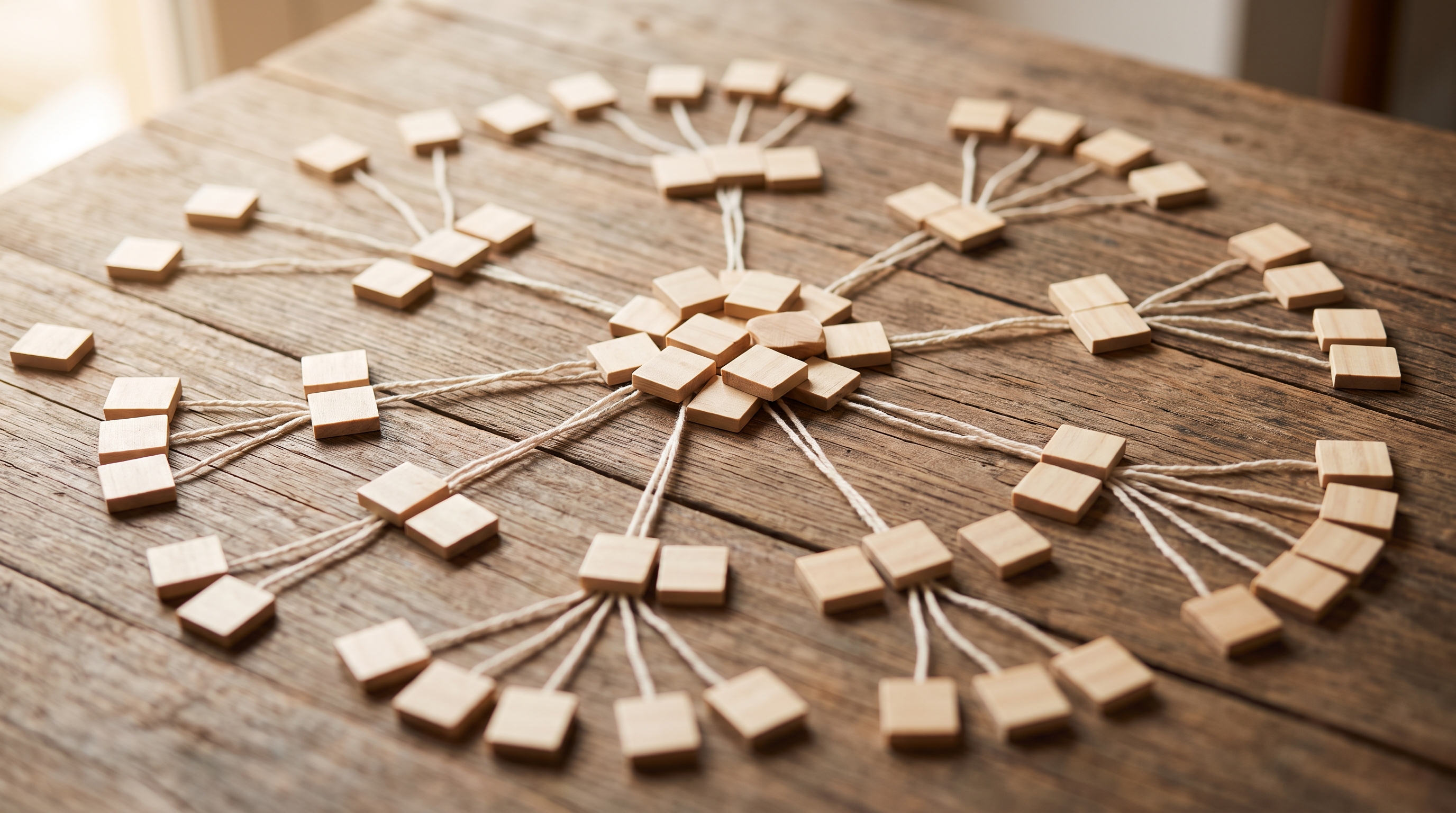
Hand someone a word search and they scan for letter patterns. Hand them a word association game and their brain does something entirely different: it reaches into memory, experience, and instinct to find a thread that connects two ideas. One exercise tests pattern recognition. The other exercises how you think.
Most people lump them together under "word games" and move on. That misses what makes the format work.
The Lateral Engine Hiding in Plain Sight
A word association game is an exchange of words connected by association. The format is built on the idea that a single word stimulates a pattern of linked ideas in your mind , and the game simply makes that process visible.
Someone says "mountain." Your brain does not search a mental dictionary. It fires off a web of connections: summit, snow, climb, altitude, valley. The word you actually say reveals which pathway your mind took. That is the core mechanic, and it is not a vocabulary test. You do not need to know more words than the next person. You need your brain to traverse its own associative network faster.
The format works because there are no right or wrong answers. Each word just needs to connect somehow to the one before it. A chain can go from "coffee" to "morning" to "alarm" to "fire" in four moves, and every link is valid if the player can explain the connection. The game measures associative reach, not lexical depth.
How the Game Actually Works
The mechanics are simple enough to explain in a breath. One player says a random word. The next player responds with a related word, and the chain continues. Each player must answer without hesitating for more than a predetermined number of seconds, generally no more than 5. No repeating words that have already been used.
That 5-second ceiling helps keep the game quick and encourages unfiltered responses. It strips out the editor, the part of your mind that wants to sound clever or avoid embarrassment. What comes out is the unfiltered response , the first connection your brain made, not the one you curated. The objective is to say an associated word without hesitation.
A round ends when someone repeats a word or freezes. The last player standing gets the point. Then someone picks a new starter word and the whole thing resets. The format is self-correcting: play too fast and you risk a nonsense connection; play too slow and you are out. The sweet spot is the speed of honest thought.
Variants That Prove the Point
The sheer range of ways people have adapted this format tells you something about what it actually exercises. If it were just about word recall, you would not get this many spin-offs.
The classic version accepts the first word that comes to mind. But a stricter variant demands that connections be strictly obvious, not personal or obscure. Another flips the goal entirely: Word Disassociation, where the aim is to say a word as unrelated as possible to the previous one.
From there the family tree branches out. Category-based play restricts every response to a chosen domain. Opposites forces antonym chains. Rhyme association builds chains on sound, not meaning. Alphabet association chains words by their first letter in sequence. Movie title, synonym, and memory formats each twist the core mechanic toward a different cognitive skill.
Every variant keeps the same engine: hear a word, find a connection, speak it fast. What changes is which type of connection counts. That is how you know the game trains associative thinking, not vocabulary. A good vocabulary helps, but it cannot save you if your brain takes too long to navigate from the cue word to something connected.
What Jung Saw in a Split-Second Response
Carl Jung built an entire psychological method around this idea. He theorized that people connect ideas, feelings, experiences and information by way of associations , and he believed those associative patterns were not random. They were organized into what he called complexes, clusters of linked ideas in the unconscious that shaped behaviour without the person realizing it. He believed that word association exercises might provide clues about someone's character.
The practical applications went beyond the clinic. Market researchers adopted word association to test whether product names conveyed the right message. In the 1950s, James Vicary tested the word "lagered" for a brewing company. About a third of his subjects associated the word with beer. Another third associated it with tiredness, dizziness and so forth. The brewery did not use the word.
A single word carried two entirely different associative loads, and the wrong one would have sunk the product. That is the same mechanism that makes the game revealing to play: your associations are not universal, and watching where someone else's chain goes tells you something about how they think that a vocabulary test never would.
What Changes After You Play Regularly
The benefits cluster around speed and flexibility, not recall.
Word association games hone language skills and vocabulary as a side effect , but the primary gains are elsewhere. They encourage quick thinking and creative connections , the kind of mental agility that kicks in when you need an idea now, not after five minutes of deliberation. In a group, they also build teamwork , relieve stress, and improve social skills and camaraderie.
There is a subtler gain too. Word association games help players understand the connection between experience and perspective. Two people hear the same word and reach for different associations because they bring different histories to the table. Playing regularly makes that visible in a low-stakes way, which is why teachers use the format to help students navigate disagreement and see how someone else arrived at a different answer.
Not a Word Search. Not Even Close.
A word search asks you to find a predetermined string of letters in a grid. You scan left to right, diagonal, backwards. The task is visual pattern matching. There is exactly one correct location for each hidden word, and success means you spotted it.
A word association game has no grid, no hidden strings, and no single correct answer. The task is associative reasoning: hear a cue, reach into your mental network, return with a linked word. Success means your brain traversed the network fast and found a connection the group accepts.
The difference matters because the two formats build different skills. Word searches train visual scanning and sustained attention. Word association games train lateral thinking, the ability to move sideways from one idea to another without a map. That maps more directly onto real-world problem solving, where the path from problem to solution is rarely a straight line.
Clume takes this format further. Its clues are word-association prompts that you do not just respond to, you deduce from. Instead of hearing a word and giving the next one, you receive a clue and work backwards to find the target word that connects them all. It is word association turned into deduction, played against a set of linked clues rather than an open chain. The same associative engine powers both experiences. The difference is that Clume gives that engine a destination.
If you already play word games to build vocabulary, word association adds a layer those formats do not reach: it trains how your brain moves between ideas, not just how many ideas it holds.