How to Read a Cryptic Crossword Clue With Two Meanings
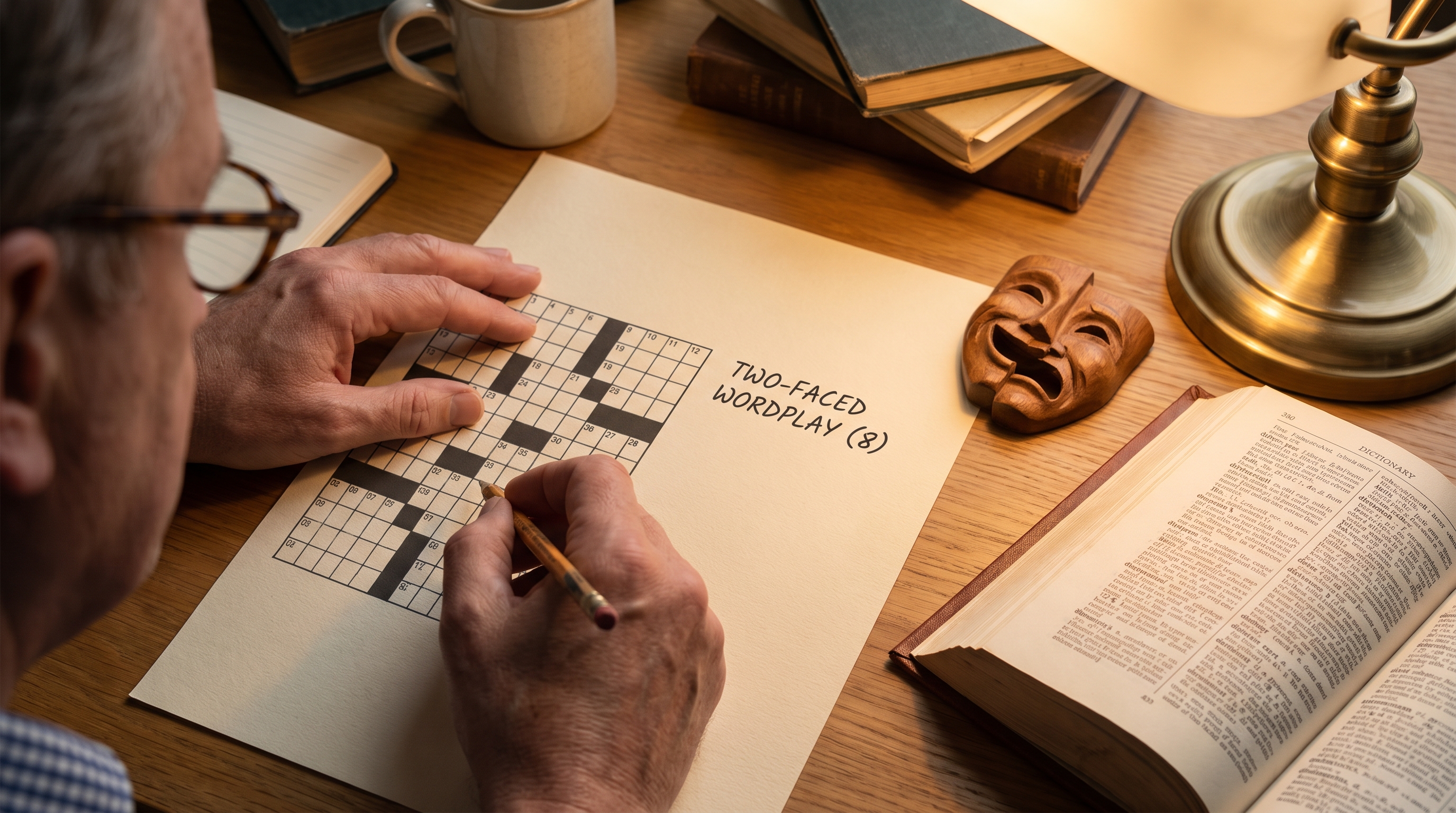
"Cover for the head gangster (4)" looks like a sentence that has given up on grammar. It is a cryptic clue, and the answer is HOOD: a cover for the head, and also a gangster. The (4) tells you the answer has four letters. Every clue in a cryptic crossword works like this one, two clues fused into a single misleading line, and once you can see the seam the whole puzzle turns from gibberish into a system you can work. Here is how to read one, starting with the purest case: the clue that holds two plain meanings at once.
Every cryptic clue is two clues in one
In a standard crossword, the clue is just a definition. In a cryptic it has two distinct parts: a normal definition of the answer, and a second hint built from wordplay. The catch is that a good cryptic clue is worded misleadingly, the definition may sit before the wordplay or after it, and there is often no punctuation to mark the join. So the first job, every time, is to find the seam: decide which half is the plain definition, then work the other half as wordplay. That is the core move in solving cryptic clues.
A few habits make the seam easier to find. The YAGCC solving guide offers three. First, by its own guess at least 95% of clues put the definition at the very beginning or the very end of the line, so try reading the first and last words as the definition before anything else. Just testing the first or last word or two will often account for at least 80% of definitions. Second, two-word clues are extremely likely to be double definitions. Third, expect the trick you have just learned to be turned against you: once you know that flower can mean river, the double-bluff is waiting in the clue where flower turns out to mean daisy.
The double definition: two meanings, no machinery
The simplest kind of wordplay hint is a second definition. These clues stack two very different definitions of the same word and let the surface reading mislead you. "Little bit of fish (3)" is DAB, which is a type of fish and also a small amount of something. "Man's understanding (3)" is KEN, a slightly uncommon word for knowledge that is also a man's name. Nothing is scrambled or hidden. The whole trick is that both halves are true at once, and the fun is in the word that carries both.
The rest of the wordplay toolbox
Beyond the double definition, the wordplay takes a handful of recognisable shapes:
- Anagram. The clue shows the answer's letters scrambled, with a signal word such as mixed, aimless or fractured. "Wild West food (4)" is STEW.
- Hidden answer. The answer is tucked inside the clue itself, signalled by phrases like caught in, buried in, part of or housed by. PLEAD hides inside "apPLE A Day", and CAT is "Lover of birds imprisoned in Alcatraz (3)".
- Homophone. The answer sounds like other words, signalled by we hear, so it's said or orally. "Animal is naked, we hear (4)" is BEAR.
- Charade. The answer breaks into parts defined in sequence. FARMING splits into far and Ming, clued as "Agriculture in remote Chinese dynasty (7)".
- Container. One part sits inside another. CALLOW puts all inside cow: "Bovine has eaten everything green (6)".
- Cryptic definition. The whole clue is one misleading definition, often flagged with a question mark. "Mug with a mug? (4)" is TOBY, a drinking vessel with a face.
Check the answer against every clue you have
A candidate that satisfies one half of the clue and quietly ignores the other is wrong, however strong it feels. Puzzle solvers call that a red herring, and spotting one in a clue word puzzle is a skill of its own. The picture that helps most is overlapping circles: each clue describes a set of possible words, and the answer lives where the circles meet. A word that sits inside one circle and outside another is out, however good the single connection feels.
Where to find free daily cryptics
You do not need a newspaper subscription to practice. The Toronto Star's games site runs a free daily cryptic pitched as not too difficult and sized for a coffee break. For more volume, the Crossword App publishes a brand new crossword every day alongside 750+ professional archive puzzles, with coins and streaks for free play and a subscription for unlimited access. One of its reviewers says they are teaching themselves cryptics from the app's cryptic packs.
The same move, one puzzle a day
Why bother learning this? Because a clue with two meanings is a small daily exercise in holding two readings at once and letting the evidence choose. That is also the muscle Clume exercises every day: a daily word deduction game with one hidden word and up to ten clues, where you start with just the first. Make a guess and another clue is revealed; each new clue adds information but also adds to your final clue count, so the aim is not just the answer, it is the answer in as few clues as possible.
The clues are built to change meaning as you go. One might simply read Interest, which could suggest finance, curiosity, attention or attraction. A later clue makes one of those readings more likely, and a later one still may reveal that the answer was never a direct synonym at all but a larger concept connecting every clue. A clue that looks vague on its own can suddenly make sense next to the ones you already have.
Unlike a cryptic, there is no anagramming and no rare vocabulary: Clume does not ask you to rearrange letters, find words of a particular length or recall obscure definitions, and the answers are ordinary words. There is one new puzzle every day, the same one for everyone, and nothing behind it: no endless feed and no pressure to keep playing for hours. A puzzle normally takes a few minutes. Playing is free, with an optional Supporter subscription for people who want their games and statistics recorded. If you already enjoy cryptic crosswords, Sudoku, Connections, logic puzzles or riddles, it is likely to appeal to exactly that crowd.