What Is Clume?
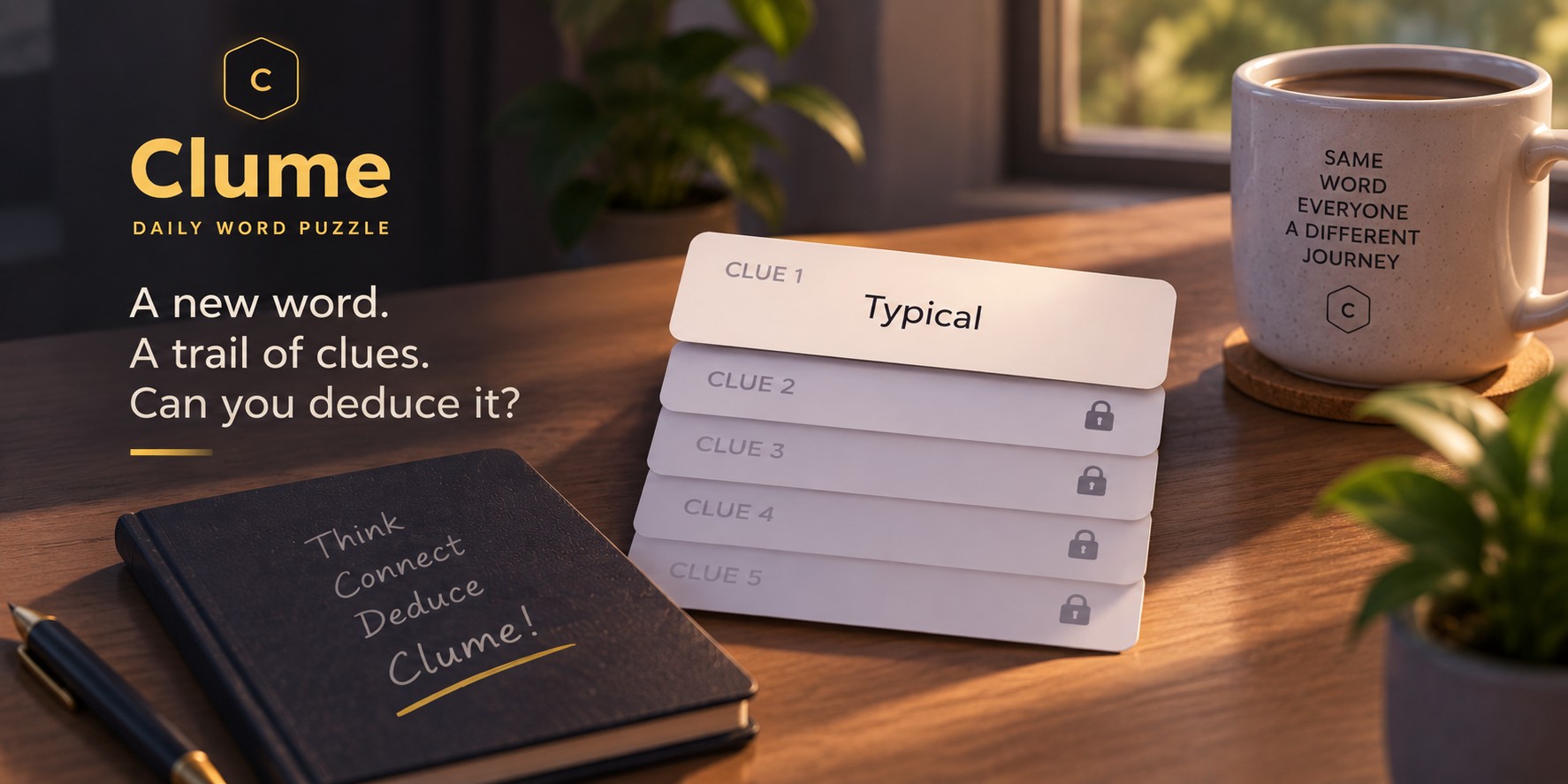
Clume is a daily word game built around deduction, concept recognition and the satisfying moment when all the clues suddenly make sense.
There are plenty of daily word games, but they do not all test the same kind of thinking.
Wordle asks you to eliminate letters. Crosswords test vocabulary and general knowledge. Sudoku is built around pure logic. Connections challenges you to spot hidden relationships between words.
Clume is about deduction and concept recognition.
Instead of guessing letters, you are trying to identify a hidden word from a series of clues. The clues appear one at a time, gradually narrowing the possibilities until the answer suddenly becomes clear.
That moment of recognition — when several seemingly broad clues finally connect — is what Clume is built around.
How Clume Works
Every day, Clume presents one hidden word and up to ten clues.
You begin with the first clue and make a guess. If your guess is wrong, the next clue is revealed. Each new clue gives you more information, but it also increases your final clue count.
The aim is not simply to find the answer. It is to find it using as few clues as possible.
Everyone receives the same daily puzzle, so you can compare your result with friends or share how quickly you solved it.
A puzzle normally takes only a few minutes, but the answer may stay in your head much longer.
What Kind of Word Game Is Clume?
Clume sits somewhere between a traditional word puzzle and a logic puzzle.
| Puzzle | Main skill |
|---|---|
| Wordle | Vocabulary and elimination |
| Sudoku | Pure logic |
| Quick crossword | Vocabulary and knowledge |
| Clume | Deduction and concept recognition |
| Connections | Finding hidden relationships |
| Cryptic crossword | Lateral thinking and deduction |
Clume does not ask you to rearrange letters, find words of a particular length or recall an obscure definition.
Instead, it asks a different question:
What single idea could connect all of these clues?
An early clue might have several possible meanings. A second clue may point in another direction entirely. As more clues appear, the possible answers begin to overlap.
Eventually, one word fits them all.
The Clues Are Designed to Change Meaning
A Clume clue is often deliberately broad when seen on its own.
For example, a clue such as Interest could suggest finance, curiosity, attention or attraction. Another clue might make one of those meanings more likely. A later clue may reveal that the answer is not a direct synonym at all, but a larger concept connected to every clue.
This is why playing Clume can feel similar to solving a good cryptic crossword clue.
You may spend several guesses looking at the clues in one way, then suddenly realise they were pointing towards something else all along.
That change in perspective creates the satisfying “aha!” moment at the centre of the game.
Is Clume Like Wordle?
Clume and Wordle are both short daily word games with one shared puzzle each day, but the way they are solved is very different.
Wordle gives you information about letters. Every guess tells you which letters are correct, incorrect or in the wrong position. The challenge is gradually eliminating possible words.
Clume gives you information about meaning.
There are no coloured letters and no fixed word length to help you. Instead, each clue adds another piece of conceptual information. You must work out what the clues have in common and which answer best explains all of them.
Wordle tests spelling, vocabulary and elimination.
Clume tests deduction.
Who Is Clume For?
Clume is likely to appeal to people who enjoy crosswords, cryptic crosswords, Sudoku, Connections, logic puzzles, riddles and lateral-thinking problems.
You do not need to be a crossword expert or have an enormous vocabulary. The answers are ordinary words and concepts. The challenge comes from recognising the connection between the clues.
Some puzzles may click immediately. Others may lead you through several convincing wrong answers before the real solution appears.
Both are part of the game.
Why Every Guess Matters
In Clume, a wrong guess is not wasted.
Every incorrect guess reveals another clue, and every clue moves you closer to the answer. Even an incorrect idea can help you understand what the puzzle is — and is not — pointing towards.
This makes Clume approachable even when a puzzle initially feels difficult. You are never expected to solve every word from the first clue. The game is about following the trail and seeing how quickly you can reach the destination.
Solving in two or three clues feels impressive.
Solving in nine or ten clues can feel just as satisfying when the answer finally makes sense.
One Puzzle, Once a Day
Clume has one new puzzle every day, with the same word for everyone.
There is no endless feed and no pressure to keep playing for hours. You solve the daily word, share your result if you choose, and return tomorrow for a new challenge.
It is a small daily test of deduction, pattern recognition and flexible thinking.
Ready for Your Next Daily Challenge?
Love crosswords, Sudoku and Connections?
Clume is your next daily challenge.
Follow the clues, trust your deductions and see how quickly you can find today’s hidden word.