Games Like NYT Connections: Try a Different Kind of Daily Word Puzzle
If you enjoy NYT Connections, there is a good chance the part that keeps you coming back is not simply the words. It is the deduction: spotting possibilities, avoiding tempting wrong answers, and waiting for the moment when the puzzle suddenly makes sense.
If that is what you like about Connections, Clume may be worth adding to your daily puzzle routine.
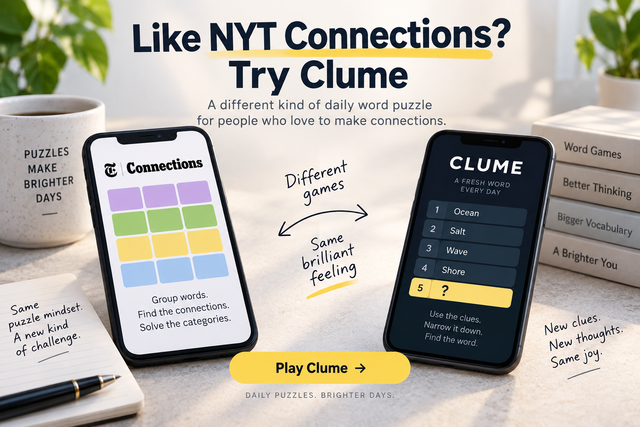
Clume is not a Connections clone. Instead of sorting sixteen words into four hidden groups, you are trying to identify one hidden word. Clues are revealed one at a time, and the challenge is to solve the word using as few clues as possible.
Why Connections players may enjoy Clume
Connections and Clume use very different mechanics, but they exercise some of the same puzzle-solving instincts.
You have to keep more than one possibility in mind
In Connections, a word can appear to belong to several plausible categories. Committing too quickly can send you in the wrong direction.
Clume creates a similar problem in a different way. An early clue may fit dozens of possible answers. A second clue narrows the field, but it may also make one particularly tempting answer feel much more certain than it really is.
The trick is knowing when you have enough information to commit.
That is one reason some word puzzle guesses feel right even when they are wrong. A plausible answer is not necessarily the answer that explains every clue.
Misdirection matters
Some of the most memorable Connections boards contain words that seem designed to pull you towards the wrong grouping.
Clume can create the same feeling with individual clues. A clue may strongly suggest one interpretation while still being completely valid for the hidden word.
We have written more about this in How to Spot a Red Herring in a Clue Word Puzzle.
There is an “aha” moment
The best daily puzzles often have a point where scattered information suddenly locks together.
With Connections, that might happen when you finally see the relationship between four words that looked unrelated. In Clume, it happens when several clues that seemed vague suddenly point to the same hidden word.
That process is at the heart of a deduction puzzle: each new piece of information reduces the number of explanations that still make sense.
How Clume is different from Connections
The biggest difference is the shape of the puzzle.
Connections gives you all sixteen words at once and asks you to organise them. Clume starts with much less information. You see one clue, make a guess, and then decide whether you need another clue.
That creates a different kind of risk.
You can always reveal more information, but doing so increases the number of clues used to solve the puzzle. The aim is not merely to get the answer eventually; it is to work it out efficiently.
If you want to understand the format in more detail, What Is Clume? explains how a full daily game works.
Clues replace categories
Connections asks: What relationship joins these words?
Clume asks: What single word could explain all of these clues?
Suppose an early clue has several obvious interpretations. Rather than trying to force it into a category, you build a mental shortlist of possible answers. The next clue either strengthens those possibilities or eliminates them.
Our guide to using clues to narrow down a word puzzle explores that process in more detail.
One puzzle a day
Like many of the best-known daily word games, Clume gives everyone the same puzzle for the day.
That matters because a daily puzzle is as much a routine as it is a game. You play, see how quickly you solved it, share or compare the result if you want to, and come back tomorrow for a fresh challenge.
Clume is deliberately short enough to sit alongside the other puzzles you already play rather than replace them.
Is Clume actually similar to Connections?
Mechanically, not very.
If you specifically want another game where you divide sixteen words into four groups, Clume is not trying to reproduce that format.
But if what you enjoy is word association, deduction, misleading possibilities and the satisfaction of making the right connection before you run out of chances, there is a meaningful overlap.
That is why Clume can work particularly well as the puzzle you play after Connections rather than as a substitute for it.
Why daily word puzzles work so well together
A lot of people do not play just one daily puzzle.
They might have a morning routine that includes Wordle, Connections, a crossword, a logic puzzle, or something else entirely. Each game scratches a slightly different itch.
Connections is about grouping and relationships.
Clume is about narrowing possibilities from clues.
That difference is exactly why the two can sit comfortably alongside each other.
You can finish Connections and still have room for another puzzle that uses some of the same instincts without simply repeating the same mechanic.
Try today's Clume
There is one new Clume puzzle every day, and it only takes a few minutes to play.
Your challenge is simple: work out the hidden word while revealing as few clues as you can.
If you want to explore more of the thinking behind word puzzles, you can also read about how word games build vocabulary and browse the rest of the Clume articles.