What Is a Deduction Puzzle? The Difference Between Logic Grids, Crosswords, and Clue-Based Word Games
Most people call anything that makes them think a "logic puzzle." But the word "deduction" gets thrown around loosely too, and the mess grows from there. A crossword is not a logic grid. A logic grid is not a word game. A clue-based word game like Clume is not any of the above. They all use deduction, but they use it differently, and knowing the difference changes how you solve.
What Is a Deduction Puzzle?
A deduction puzzle is a puzzle deriving from the mathematical field of deduction. The core demand is always the same: you are given a set of clues and constraints, and you must eliminate possibilities until only one solution remains. You are not looking for proof that a particular answer is correct. You are proving that every other answer is impossible, and what survives is your solution.
The format itself dates back to Lewis Carroll, who created the first logic puzzle in his book The Game of Logic. Carroll asked readers to confirm conclusions like "Some greyhounds are not fat" from premises such as "No fat creatures run well" and "Some greyhounds run well." These early puzzles, called syllogisms, gave you a list of premises and asked what you could deduce from them.
In the second half of the 20th century, mathematician Raymond Smullyan expanded the field with books like The Lady or the Tiger? and To Mock a Mockingbird. He popularized the "knights and knaves" puzzles, where knights always tell the truth and knaves always lie. The format has since branched into logic grids, truth-teller puzzles, nonograms, Sudoku, and more.
The unifying thread is the elimination engine. Read the clues, cross off what cannot be true, and repeat. Different puzzle formats just run that engine on different fuel.
Logic Grid Puzzles: Deduction by Elimination Table
The logic grid is the format most people picture when someone says "deduction puzzle." A scenario is given, along with a set of clues, and you fill out a matrix to deduce the solution. A typical setup: five people brought five dogs to a show, each dog is a different breed, and clues like "neither Misty nor Rex is the German Shepherd" narrow the field.
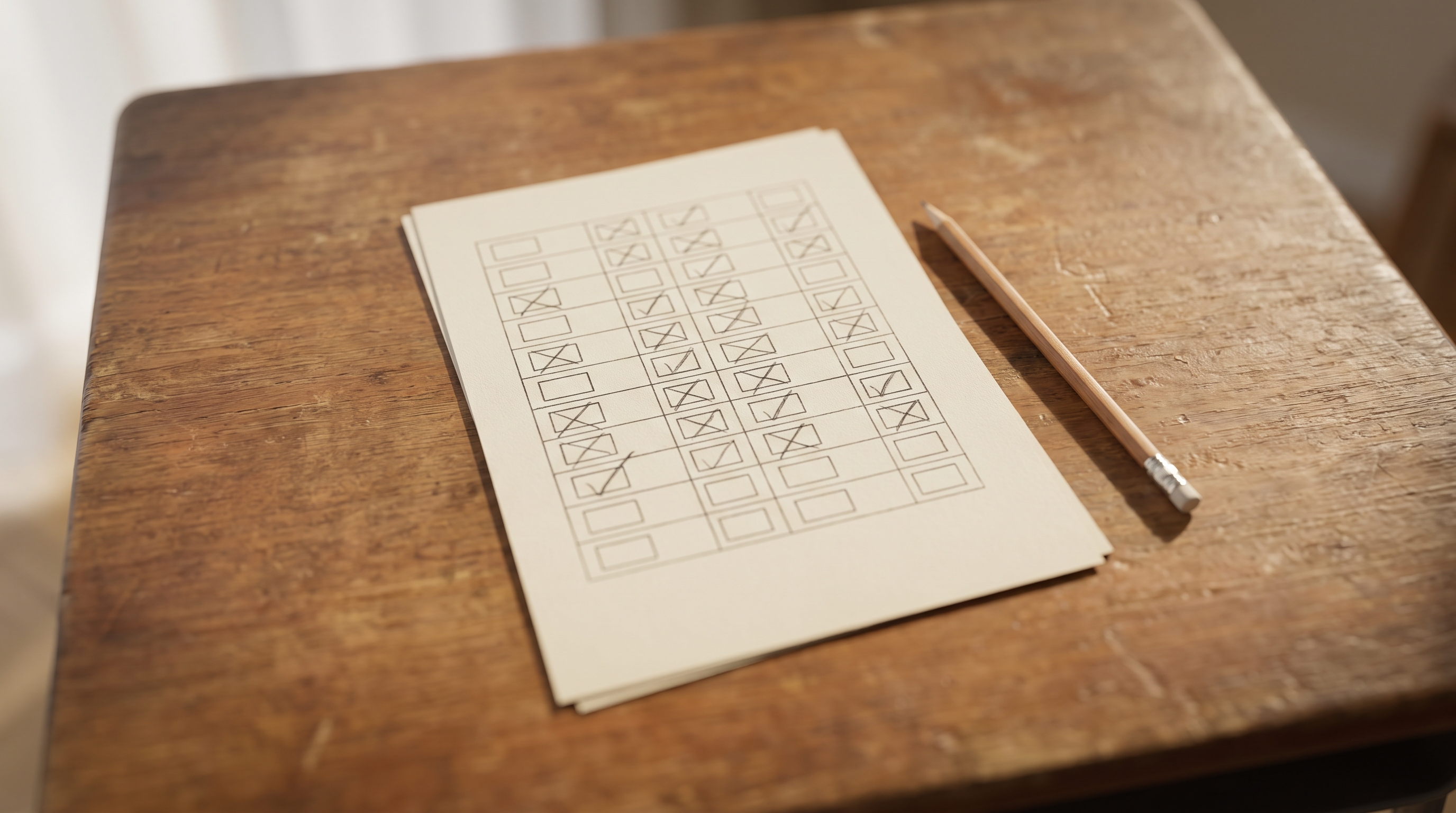
The grid is a visual tool for cross-referencing. Rows represent one category (people), columns represent another (dog breeds), and each cell is a yes or a no. You proceed by reading a clue, marking the corresponding cell, and propagating the consequences. If Misty is not the German Shepherd, you mark an X. If that leaves only one breed for Misty, you mark a check and eliminate that breed from everyone else. One deduction feeds the next.
The most famous example is the Zebra Puzzle, often called Einstein's Puzzle or Einstein's Riddle, published in Life International magazine on December 17, 1962. The March 25, 1963, issue of Life contained the solution and the names of several hundred successful solvers from around the world. The puzzle asks: who owns the zebra? It layers five houses, five nationalities, five drinks, five cigarettes, and five pets into a single interdependent matrix. The urban legend that Einstein invented it as a boy is just that, a legend, but the puzzle's difficulty is real.
Logic grids scale in difficulty by adding more categories and dependent clues. A two-category grid is a warm-up. A five-category grid with clues that require chaining three or four deductions together is where the format earns its reputation. The mechanism stays the same: eliminate, propagate, repeat. The weight comes from how many dominoes you have to line up before the first one falls.
Crossword Puzzles: Deduction by Pattern Matching
Crosswords sit in a different category entirely. A crossword is a word game consisting of a grid of black and white squares into which solvers enter words or phrases crossing each other horizontally and vertically according to a set of clues. The deduction is real, but it runs on a different engine.
Where a logic grid asks you to eliminate possibilities from a closed set of options, a crossword asks you to retrieve a word from your vocabulary that matches both a definition and a pattern of intersecting letters. The constraint is the grid. Each across word must interlock with each down word at every shared square. A wrong answer in one direction breaks the other, and the break is visible immediately.
The deductive mechanism in a crossword is letter-by-letter constraint propagation. You fill in an across answer you are confident about. That gives you the first letter of a down answer. The down clue, plus the known letter, narrows the possibilities. You try a word that fits. It gives you more letters for the next across clue. The puzzle solves itself in a cascade of mutual checking.
This is deduction, but it is deduction backed by knowledge and vocabulary rather than pure logic. A logic grid could be solved by someone who speaks no English, given the clues in symbolic form. A crossword cannot. The format rewards what you know as much as how you reason.
Clue-Based Word Games: Deduction by Iterative Testing
Between the pure logic of grids and the knowledge-driven pattern matching of crosswords sits a third category: clue-based word games. Here, deduction is iterative and sequential. You do not get all the information at once. You make a guess, receive feedback, and use that feedback to refine the next guess.
The classic board game example is Cluedo (known as Clue in North America), devised in 1943 by British board game designer Anthony E. Pratt and first manufactured by Waddingtons in 1949. Players move through a mansion suggesting suspects, weapons, and rooms. Each suggestion is checked by the other players, who reveal cards that narrow the possibilities. The deduction is cumulative: you track what has been shown and what has not, and you eliminate suspects one card at a time.
Other classic deduction games follow the same iterative pattern. Scotland Yard (1983) has players track a hidden fugitive across a map of London using revealed travel tickets as clues. Code 777 (1985) gives each player a set of number tiles they cannot see themselves, and they must deduce their own tiles from what others reveal.
The digital age produced a new wave of this format. Wordle turned the iterative guess-and-feedback loop into a daily ritual. Clume, developed by Playclume, fits squarely in this lineage: it is a daily word mystery game where players reveal clues and make guesses to solve a hidden word in ten chances. Each guess triggers a new clue, and players use those clues to deductively refine the next attempt. The key difference from a logic grid is that the information arrives in sequence. You cannot solve the whole puzzle from the first clue. You have to act, observe, and adjust.
This is what separates clue-based word games from logic grids. The deduction is not simultaneous. It unfolds over time, and your strategy adapts as each new piece of information arrives. Learn more about how Clume works and how to use clues to narrow down your guesses.
The Hardest Deduction Puzzle Ever
For a sense of how far pure deduction can go, stripped of grids, words, and feedback loops, consider the puzzle that philosopher George Boolos named "The Hardest Logic Puzzle Ever" and published in The Harvard Review of Philosophy in 1996.
The setup: three gods, labeled A, B, and C, are called True, False, and Random in some unknown order. True always speaks truthfully. False always lies. Random answers arbitrarily. Your task is to determine the identities of all three by asking three yes-no questions, each directed at one god. The gods answer in their own language, where the words for yes and no are "da" and "ja," and you do not know which is which.
There is no grid. There are no word clues. There is only the logic of truth-tables and counterfactual questions. Boolos credited Raymond Smullyan as the originator of the puzzle and John McCarthy with adding the unknown-language complication. The puzzle descended from Smullyan's earlier writings, where island natives answered "Bal" or "Da," one meaning yes and the other no, and the visitor had to figure out which was which along with everything else.
The puzzle is not about vocabulary, pattern recognition, or iterative guessing. It is about constructing questions whose answers are informative regardless of whether the respondent is lying or telling the truth, and regardless of what "da" and "ja" mean. The solution requires embedding one question inside another, a technique known as the embedded question lemma, where asking "If I asked you Q, would you say ja?" yields the truthful answer to Q no matter who you ask or what the words mean.
It is a useful limit case. It shows that deduction, at its purest, needs no board, no cards, no screen. Just a set of constraints and the patience to work through them.
Which Format Is Right for You?
The three formats map to different ways of thinking, and the best fit depends on what you enjoy about the process.
Logic grids reward systematic thinkers. You need patience and a methodical approach. The work is mostly in setting up the matrix and tracking eliminations. The satisfaction comes from watching a full grid resolve itself one cell at a time. If you like cross-referencing and building chains of inference, this is your format.
Crosswords reward language lovers. The deduction is real, but it is inseparable from vocabulary, trivia, and wordplay. A crossword clue is as much a riddle as a constraint. The satisfaction comes from the interplay between what you know and what the grid tells you. If you enjoy the feeling of a word snapping into place because three crossing letters demand it, this is your format.
Clue-based word games reward iterative explorers. You do not need a large vocabulary or a head for truth-tables. You need a willingness to make a guess, read the feedback, and adjust. The satisfaction comes from the narrowing, the sense that each guess brings you closer. Clume sits at this intersection: it is a word game that uses deduction as its core mechanic, and it is built for the daily puzzle habit that Wordle made familiar.
The formats are not rivals. They are different paths to the same reward: the moment when the last possibility falls away and the answer stands alone.