Deduction Puzzles: From Logic Grids to Daily Word Games
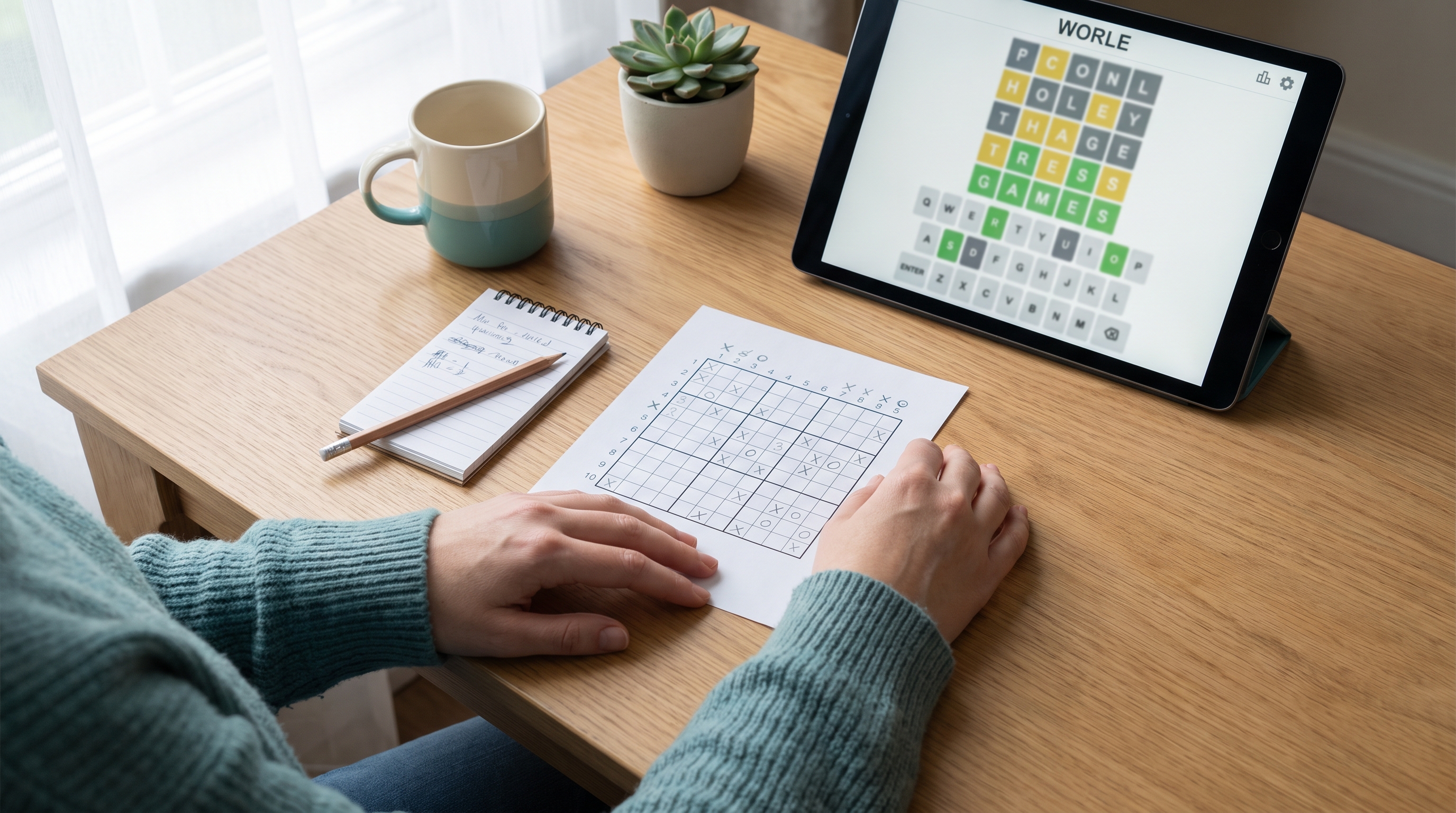
Most word games reward what you already know. A deduction puzzle is the branch built differently: it hands you a set of hints, none of which names the answer directly, and asks you to find the thread that ties them together. Wordle asks what letters fit. A crossword asks what you know. A clue-based deduction puzzle asks what the clues point to. What follows maps the category: logic grids on paper, deduction at the table, and the daily word version, with a place to start in each.
What counts as a deduction puzzle
The test is what the clue asks of you. Vocabulary recall means knowing definitions, retrieving words from memory and matching letters to form valid answers. Clue-based deduction means taking hints that never name the answer and working out what connects them.
An example puts the line on the ground. A printable synonym crossword on WordMint runs ten clues with answers from three to six letters, and its clues read "synonym for quick" and "synonym for beautiful". The clue names the meaning outright, so the work is recall: a word you either know or do not. A deduction clue cannot be settled that way, because the answer is whichever single word connects several ideas at once.
Logic grids: deduction on paper
This is the version popular among puzzle enthusiasts and available in magazines dedicated to the subject. You get a scenario (who brought which dog to the dog show, and what breed each dog was), clues such as "neither Misty nor Rex is the German Shepherd", and a matrix to fill in as you deduce the solution. Most puzzles keep to two, three or four categories, because complexity climbs fast beyond that. The most famous example is probably the Zebra Puzzle, which asks who owned the zebra.
The branch is older than it looks. Logic puzzles were first produced by Charles Lutwidge Dodgson, better known as Lewis Carroll, the author of Alice's Adventures in Wonderland. His book The Game of Logic asked readers to confirm a conclusion such as "some greyhounds are not fat" from premises like "no fat creatures run well" and "some greyhounds run well", and he went on to build puzzles from as many as eight premises.
To try one today, Daydream Puzzles keeps a collection of logic grid puzzles that are free to play online using interactive grids. There is no account to create: you start playing, and your answers are checked automatically when you complete the grid. Every puzzle is human-created, and if you would rather work on paper there is a section of blank grids to print. A guide for beginners and a set of advanced techniques are there too.
Clue-based word deduction: the daily branch
The other branch is built for one person and a few minutes. Clume is a daily word deduction game. Each day there is one hidden word and up to ten clues. You begin with a single clue and make a guess; if the guess is wrong, the next clue is revealed. Every new clue adds information, but it also adds to your final clue count, so the aim is not simply to find the answer. It is to find it using as few clues as possible. Everyone receives the same daily puzzle, so you can compare clue counts with friends or share how quickly you solved it. A puzzle normally takes only a few minutes, but the answer may stay in your head much longer.
The clues are built to change meaning as you go. A clue like Interest could suggest finance, curiosity, attention or attraction. A later clue might make one of those readings more likely, and a later one still might reveal that the answer was never a direct synonym at all, but a larger concept connected to every clue. The picture that helps most is overlapping circles: each clue describes a set of possible words, and the right answer lives where the circles meet. A guess that sits inside one circle and outside another is a red herring, however strong the single connection feels.
Two things are worth knowing before you start. The information arrives in sequence, which is the key difference from a logic grid: you cannot solve the whole puzzle from the first clue, so you have to act, observe and adjust. And the vocabulary bar is low on purpose. Clume does not ask you to rearrange letters, find words of a particular length or recall an obscure definition; the answers are ordinary words, and the challenge is recognising the connection between the clues. That is also why it is likely to appeal to people who enjoy crosswords, cryptic crosswords, Sudoku, Connections, logic puzzles, riddles and lateral-thinking problems.
Where Wordle sits in all this: it turned the iterative guess-and-feedback loop into a daily ritual, and Clume sits squarely in that lineage. But the two do not test the same thing. Wordle asks you to eliminate letters from five-letter words you recognise. Clume measures how well you hold several possible meanings in your head at once, and how fast you let go of one when the evidence turns against it.
The one-a-day format is part of the design. The limit keeps the puzzle scarce, the clues keep it varied, and the incompleteness keeps you coming back. A new puzzle lands every day at midnight in your local time zone. You can play without creating an account, and playing is free. Creating an account saves your games, statistics and streaks, and after the free 7-day trial an optional Clume Supporter subscription keeps recording your games, unlocks your full statistics and removes adverts. Without it you can keep playing every day; your games and statistics just stop being recorded. There is no endless feed behind the puzzle and no pressure to keep playing for hours: you solve the daily word, share your result if you choose, and return tomorrow.
Deduction at the table
The same reasoning scales up to a group. Scotland Yard, from 1983, sends players tracking a hidden fugitive across a map of London using revealed travel tickets as clues. Code 777, from 1985, gives each player a set of number tiles they cannot see themselves, and you deduce your own tiles from what the others reveal.
A ranked list on BoardGameGeek covers 28 social deduction and hidden-role games. One entry on the list is essentially 20 Questions with a difference: one player already knows the answer, and the table is working out who knew it beforehand. There is a trick-taking entry that doubles as social deduction and one built for two players. This is the branch for a games night rather than a solo coffee break.
Matching the puzzle to the window you have
Three windows, three starting points.
Got a group and an evening? Start with Scotland Yard or Code 777, then browse BoardGameGeek's ranked list of 28 social deduction and hidden-role games.
Want paper and pen? Daydream Puzzles has free interactive logic grids online and blank printables for working by hand.
Got a quiet few minutes a day? That is the gap Clume was built to fill: one puzzle, at midnight your time, free to play, a few minutes to solve, and then done until tomorrow.
Start with Clume and the skill you are practising is holding several possible meanings in your head at once, and letting the evidence choose between them.