Why Your Brain Chases the 'Aha' Moment in Word Puzzles
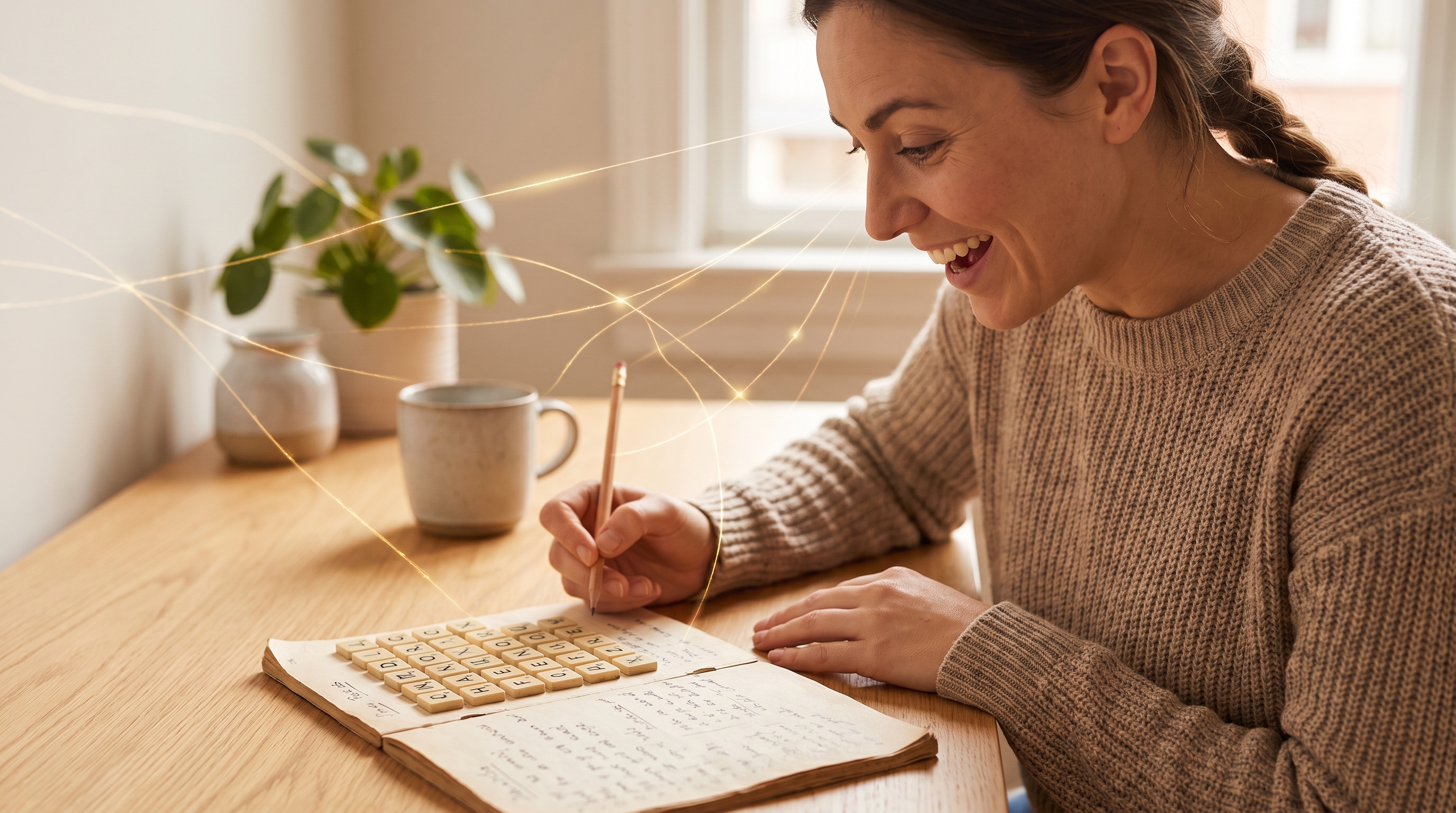
You know the feeling. You have been staring at the same puzzle for ten minutes, every idea falls flat, and you close the tab in defeat. Then, somewhere between the coffee maker and your inbox, the answer arrives whole, and you wonder how you ever missed it. Psychologists call that sudden click insight, and it does not only happen with problems: it is the same jolt as suddenly getting a joke or a crossword clue. This article is about aha moment puzzles: why the click happens, why it feels so good, and how to make it more likely.
What happens when the answer arrives
The click has a shape, and the research on how aha moments happen gives both halves. First comes the impasse: you are making no progress toward a solution, however hard you push. Then comes the arrival, which tends to show up when you are not thinking about the problem at all.
Grinding through options is the wrong tool. Solving an insight problem often requires unconscious thought, because the solution cannot simply be reached by following step-by-step instructions or a formula pulled from working memory. A study by a team of Belgian psychologists found further evidence for that split: insight engages unconscious mechanisms that differ from analytic, step-by-step reasoning, and even when people are juggling several demands on their attention, their intuitive processes may still be within reach.
Researchers still debate whether insight is the final, satisfying step of ordinary reasoning or a separate mode of thinking altogether. Either way, the moment is measurable: scientists have identified distinctive patterns of brain activity that signal when it happens.
Why the click feels so good
The moment does more than feel good. Research ties aha moments to stronger long-term memory for what you worked out, and once the click has happened, people are unlikely to slide back into not knowing. They are also confidence-boosters.
The pull is easiest to see from the outside. One writer describes how taking up jigsaw puzzles calmed her mind. Her account of the reward is precise: every piece that clicks into place brings a little rush and a sense of achievement, "a dopamine hit, but one I've worked for instead of just scrolling". The habit crept up on her, too. She caught herself resisting the urge to puzzle even with other jobs waiting, and calls it oddly addictive.
Put it together and the chase makes sense: a reward you work for rather than scroll for, an answer that stays learned, and a little more confidence with every click.
How to make the click more likely
Mood is part of the machinery. Research finds that when you are feeling happy, calm and confident, an aha moment is more likely to occur.
So build in the break: a stretch of time that lets the brain quiet down and stop chewing on the problem, phone away, music off. The same writer describes the state from the inside. A jigsaw, she found, demands complete focus, and the leaning and piece-picking are physical enough that she cannot be on her phone at the same time; she calls it an unintentionally mindful activity that calms her racing mind and helps her de-stress.
Forcing it keeps you at the impasse. Stepping away is when the answer tends to arrive.
Where word puzzles and the aha moment meet
Not every word game leans on this machinery the same way. Most reward what you already know: Wordle asks you to eliminate letters from five-letter words you recognise, and a crossword wants definitions plus general knowledge. The other branch is clue-based deduction: a set of hints, none of which names the answer, and the job of finding the thread that ties them together. What deduction measures is how well you hold several possible meanings in your head at once, and how fast you let one go when the evidence turns against it. That branch has a map of its own: what counts as a deduction puzzle lines up logic grids, crosswords and clue-based word games side by side.
Clume is our daily word deduction game: work out the hidden word from a sequence of clues. The moment of recognition, when several seemingly broad clues finally connect, is what we built it around. Every day there is one hidden word and up to ten clues. You begin with the first clue and make a guess; if the guess is wrong, the next clue is revealed. Each new clue gives you more information but also raises your final clue count, so the aim is to find the answer using as few clues as possible. Everyone receives the same daily puzzle, so you can compare clue counts with friends or share how quickly you solved it.
An early clue is deliberately broad, and the first idea that comes to mind is not necessarily the strongest one; a guess made before the second clue lands is exactly the kind that costs you. The picture that helps most is overlapping circles: each clue describes a set of possible words, and the right answer lives where the circles meet. A guess that sits inside one circle and outside another is a red herring, however strong the single connection feels.
A wrong guess is not wasted. It is the only way the next clue appears, and every clue moves you closer to the answer. The habit that pays is hypothesis testing: read the clues, form a reading, test it, and revise when the evidence shifts. There is a clean test for whether you are doing that, borrowed from fair-play mysteries: for any answer you are holding, name what would kill it. If you cannot name a fact that would falsify it, you are not testing it. You are believing it. And the red herrings are self-supplied: a broad clue leads you to plausible wrong answers all on its own.
So the loop runs: broad clue, convincing wrong reading, new clue, revised reading. The answer is rarely hidden in any single clue. It appears in the space where all the clues meet, and the path to it runs straight through the wrong answers you discard along the way. Clume suits people who already enjoy crosswords, cryptic crosswords, Sudoku, Connections, logic puzzles, riddles and lateral-thinking problems; the answers are ordinary words and concepts, and the challenge is recognising the connection between the clues. A puzzle normally takes only a few minutes, but the answer may stay in your head much longer. And that is the core of the skill in any puzzle narrowed down by clues: the answer is the word that fits every clue at once, not the word that fits the latest clue best.
How Clume builds the aha moment into your day
Clume is a daily word deduction game: one hidden word, up to ten clues, and you see only the first until you make a guess. Every wrong guess reveals the next clue, and because each clue adds to your final count, the aim is the answer in as few clues as possible. We built the game around the satisfying moment when all the clues suddenly make sense, the click this article is about. The answers are ordinary words and concepts, and the challenge is recognising what the clues have in common; a new puzzle arrives every day at midnight, the same one for everyone, and a puzzle normally takes only a few minutes. You can play for free, and an account starts a free 7-day trial that saves your games, statistics and streaks. After the trial, a Clume Supporter subscription at £14.99 a year or £1.49 a month keeps recording your games, unlocks your full statistics and gives you an ad-free experience, though you can keep playing free and become a Supporter at any time.
If you want to feel the click for yourself, start with what Clume is and how it works, then see how few clues today's answer takes you.